

Citrus Burn 2026: What Consumers Should Know About CitrusBurn Ingredients, Label Disclosures, and Supplement Facts Before Buying
A 2026 consumer information report examining CitrusBurn's proprietary blend, thermogenic supplement labeling, manufacturing disclosures, and what the Supplement Facts panel does and does not reveal
Aurora, CO, Feb. 11, 2026 (GLOBE NEWSWIRE) -- Disclaimer: This article is for informational purposes only. It is not medical advice. Weight management concerns should be evaluated by a qualified healthcare professional. This content does not diagnose, treat, cure, or prevent any disease. If you purchase through links in this article, a commission may be earned at no additional cost to you.
This release is an informational consumer report focused exclusively on publicly available label and policy disclosures. It does not evaluate outcomes, compare products, report typical results, or recommend any supplement. Readers are encouraged to consult a qualified healthcare professional for personal guidance.
With more people researching thermogenic supplement options heading into 2026, CitrusBurn's publicly available product disclosures continue to be accessible to consumers researching this category. Whether someone is encountering this product for the first time or revisiting it after seeing it mentioned elsewhere online, the goal of this report is straightforward — to present what the company has publicly disclosed in a structured format so readers can independently evaluate what is stated, what is not stated, and what may require further personal research.
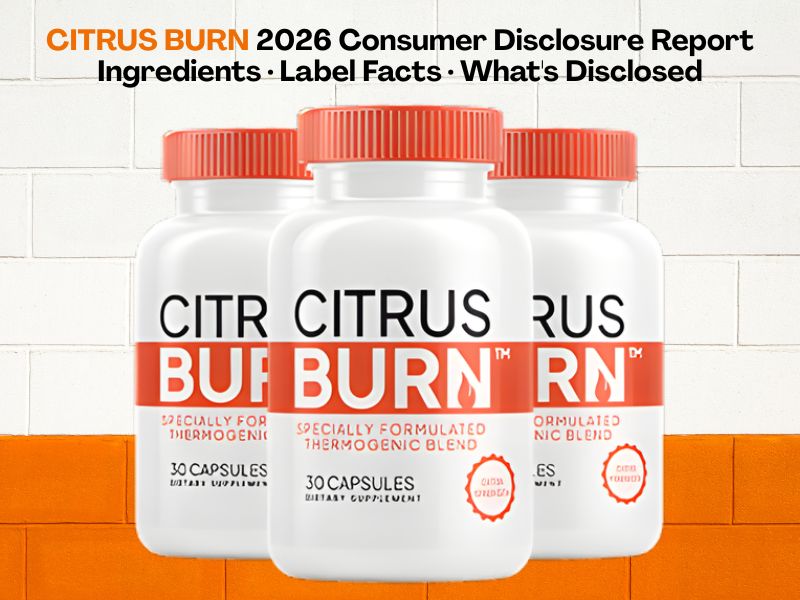
This article summarizes what Citrus Burn has made publicly available about its product, covers how supplements in this category are regulated, and walks through the kinds of label and policy details that informed consumers typically review before making any purchasing decision. Readers who prefer to start with the company's own disclosures can view the current CitrusBurn offer (official Citrus Burn page) to review everything directly.
Why Consumers Are Researching Thermogenic Supplement Options
Interest in thermogenic supplements appears to be rising, and the reasons tend to be practical rather than dramatic. Most people researching this category are simply trying to figure out what products are available, what's actually in them, and what factors might be worth considering before spending money.
That kind of research makes sense. The supplement market includes a wide range of brands and positioning approaches, marketing language can be hard to parse, and not every company makes it easy to find straightforward product details. For anyone comparing options in the thermogenic supplement category, the challenge usually isn't finding products — it's finding clear, unembellished information about those products. Readers who are also exploring the broader weight management supplement landscape may find additional category context in this informational overview of citrus-based weight management supplement disclosures.
Public health guidance commonly encourages individuals to consult with a qualified healthcare professional before beginning any new supplement regimen, and that advice applies regardless of category, brand, or marketing claims. This report is designed to support — not replace — that kind of informed decision-making.
What "Thermogenic Supplement" Typically Refers To
The term "thermogenic supplement" shows up frequently in product marketing, but it's worth understanding what it actually means at a basic level. "Thermogenic" refers to thermogenesis — the body's natural process of producing heat. It's a normal biological function involved in how the body uses energy throughout the day.
In the supplement industry, "thermogenic" is used primarily as a category positioning descriptor. It signals where a product sits within the broader supplement landscape. It does not, on its own, constitute a medical or scientific claim about what any specific product does. Products described as thermogenic are available in multiple formats — capsules, powders, liquids, and gummies — and the range of ingredient profiles, pricing structures, and disclosure practices across the metabolism-focused supplement category varies widely. Some consumers have also taken interest in citrus-derived ingredient research within this category, a topic covered in more detail in this report on citrus extract research and metabolism support trends.
For consumers doing their homework, that category label is a starting point for research, not a conclusion. Whether a product is described as a thermogenic weight management supplement or positioned under a broader wellness umbrella, what matters more is what a company actually discloses about its specific formulation, manufacturing, and policies — which is what the rest of this report focuses on.
What Consumers Often Review Before Making a Purchase Decision
Before purchasing any dietary supplement, experienced consumers tend to look past the marketing and focus on a handful of practical details that are available directly on the label or the company's website. These aren't about whether a product "works" — they're about whether a company is transparent enough to earn a closer look.
Supplement Facts panel format — Is there a complete Supplement Facts panel? Are individual ingredient amounts listed, or does the label use a proprietary blend that groups ingredients under a single combined weight?
Serving size and supply clarity — Is the serving size clearly stated? Can a consumer easily calculate how long one container will last at the recommended dosage?
Proprietary blend usage — If a proprietary blend is used, the total blend weight is disclosed, but individual ingredient amounts within the blend are not. This is a labeling approach permitted under current FDA regulations, but it's a detail that matters to many supplement researchers.
Caution and warning statements — Does the product include standard caution language about age restrictions, pregnancy, nursing, and medication interactions? The presence of these statements reflects baseline labeling compliance.
Customer support accessibility — Is contact information clearly provided? Can a consumer reach the company by email, phone, or both?
Refund policy existence — Does the company publish a refund or return policy? Are the terms stated in accessible language, or buried in legal boilerplate?
None of these factors tell a consumer whether a product is the right fit for them personally. But they do provide a framework for evaluating whether a company's disclosure practices meet the standard a consumer expects before making a purchase.
How to Distinguish Marketing Language From Label Disclosures
One of the most practical skills a supplement consumer can develop is learning to separate a company's front-end marketing copy from its regulated label disclosures. These are two very different types of information, and understanding the distinction can make the research process significantly more productive.
Marketing copy — the language found on a product's sales page, social media ads, and promotional emails — is designed to generate interest. It may use persuasive framing, highlight select ingredients, or emphasize a product's positioning within a category. While advertising claims are subject to FTC oversight, the language used in marketing materials often differs in tone and emphasis from what appears on the actual product label.
The Supplement Facts panel, by contrast, is a legally required disclosure governed by FDA labeling regulations. It lists the product's ingredients, serving size, and — depending on the labeling format — individual ingredient amounts. For consumers comparing products, the Supplement Facts panel represents the most standardized and regulation-backed source of formulation information available without independent lab testing.
This report focuses on label-level and policy-level disclosures rather than marketing language. Readers who want to evaluate CitrusBurn's positioning alongside its regulated disclosures can review both on the company's official website.
Disclosure Review: What the CitrusBurn Label Shows
The following details are drawn directly from CitrusBurn's publicly available product disclosures, including its Supplement Facts panel and product labeling. No interpretation, embellishment, or outcome language has been added.
Product format: Capsule
Serving size: 1 capsule
Servings per container: 30
Individually disclosed ingredient: Chromium (as Chromium Picolinate) — 100 mcg (286% Daily Value)
Proprietary blend total: 510 mg, containing: Green Tea Leaf Extract, Apple Cider Vinegar, Berberine HCL, Ginger Root, Cinnamon Bark Extract, Bitter Orange Fruit Extract, Cayenne Fruit, Banaba Leaf Extract, Korean Ginseng Aerial Extract, and Resveratrol
Other ingredients: Hypromellose (Vegetable Capsule), Microcrystalline Cellulose, Magnesium Stearate, Silicon Dioxide
Caution statement (from label): Do not exceed recommended dose. Not for use for those under the age of 18 or pregnant or nursing mothers. Consult with a physician prior to use especially if you are taking a medication or have a medical condition.
FDA disclaimer (from label): These statements have not been evaluated by the Food and Drug Administration. This product is not intended to diagnose, treat, cure or prevent any disease.
Distributed by: Citrus Burn, Aurora, CO 80011
Customer service: support@citrusburn.com | 1-888-833-4139
Manufacturing and Facility Disclosures
The company states the product is manufactured in the United States in an FDA-registered facility and produced in accordance with Current Good Manufacturing Practices (cGMP). FDA registration refers to facility registration and does not constitute FDA evaluation or approval of the product.
According to the company's published materials, the product is described as plant-based, soy-free, dairy-free, and non-GMO. These claims are the company's own disclosures and have not been independently verified as part of this report.
Understanding Proprietary Blends vs. Full-Disclosure Labels
Because CitrusBurn uses a proprietary blend for the majority of its formulation, it's worth taking a moment to explain what that means in practice — since this is one of the most commonly asked questions among supplement researchers.
A proprietary blend lists all included ingredients but provides only a combined total weight for the entire blend rather than individual amounts for each ingredient. In CitrusBurn's case, the proprietary blend totals 510 mg and includes ten listed ingredients. The label shows which ingredients are included and in what order — ingredients are listed by weight from highest to lowest, per FDA requirements — but it does not disclose how much of each individual ingredient is in the blend.
A full-disclosure label, by contrast, lists each ingredient with its specific dosage per serving. This format allows consumers to compare dosages against amounts used in published research and against competing products.
Both approaches are permitted under current FDA regulations. Companies that use proprietary blends often cite formula protection as the reason. Companies that use full-disclosure labels often cite consumer transparency. Neither format inherently indicates product quality — but the distinction is one that many informed supplement consumers consider relevant when comparing options.
Because proprietary blends do not disclose individual ingredient amounts, consumers who are comparing formulations often review published research independently to understand commonly studied dosage ranges. This report does not attempt to interpret or compare those ranges, but notes that proprietary blend labeling format is one factor some supplement researchers consider when evaluating Supplement Facts transparency.
How Thermogenic Supplements Are Regulated in the United States
For anyone unfamiliar with how dietary supplements are regulated, here's the short version: supplements and prescription drugs operate under very different regulatory frameworks, and understanding that difference matters when evaluating any product in this category.
In the United States, dietary supplements — including those marketed under thermogenesis-related category positioning — are regulated under the Dietary Supplement Health and Education Act (DSHEA) of 1994. Under this framework, supplements do not require pre-market approval from the FDA before being sold. Manufacturers are responsible for ensuring their products are safe and that any claims on labeling are truthful and not misleading.
The FDA requires supplement manufacturers to follow Current Good Manufacturing Practices (cGMP) and to include a Supplement Facts panel listing ingredients and serving information. The Federal Trade Commission (FTC) oversees advertising claims for dietary supplements and requires that such claims be truthful and adequately substantiated.
This regulatory context doesn't make any individual product better or worse. But it does mean that the burden of evaluating a supplement's disclosures falls, in significant part, on the consumer — which is exactly why reports like this one exist.
Refund Policy and Customer Support Disclosures
According to publicly available disclosures, the company states purchases are covered by a 180-day refund window, subject to the terms published on its official website. Readers interested in understanding the full refund framework should review those terms directly, as policies may change over time.
The company publishes multiple contact methods for customer support. According to the information listed on the CitrusBurn website, the following contact options are available:
Product support (Citrus Burn direct):
Phone: +1 (800) 985-7325 (listed as available 24/7)
Email: support@citrusburn.com
Order and billing support (ClickBank, retailer):
Self-service: https://www.clkbank.com
Phone (USA): 1-800-390-6035
Phone (International): +1 208-345-4245
CitrusBurn is sold through ClickBank, which serves as the authorized retailer for order processing and billing. Consumers with questions about charges, order status, or refund processing may contact ClickBank directly through the channels listed above. Product-specific questions — including questions about ingredients, usage, or shipping — are handled through the company's direct support channels.
The availability of multiple clearly published contact methods is one of the transparency factors many consumers consider when researching supplement companies. This section is provided for informational purposes and does not constitute an endorsement of the company's customer service quality.
When to Consult a Healthcare Professional
Dietary supplements in the thermogenic category are widely available without a prescription, but that accessibility doesn't eliminate the value of professional guidance. Certain individuals may want to discuss supplementation with a qualified healthcare professional before use — particularly those with pre-existing health conditions, anyone currently taking prescription medications, pregnant or nursing mothers, and individuals under the age of 18.
The company's own labeling echoes this guidance, specifically advising consumers to consult a physician prior to use if they are taking medication or managing a medical condition. That's standard labeling language, but it's there for a reason — and it applies to every product in this category, not just this one.
Where to Review Full Product Disclosures
Consumers interested in reviewing CitrusBurn's complete product disclosures — including the full Supplement Facts panel, ingredient sourcing details, current pricing, and refund policy terms — can access this information through the company's official website. For anyone comparing products within the thermogenic supplement category, primary-source review is always the most reliable approach.
Readers can view the current CitrusBurn offer (official Citrus Burn page) to review the company's complete disclosures directly.
As with any dietary supplement, the most reliable source of product information remains the official label and company-published disclosures. Secondary summaries, social media discussions, and promotional content may vary in tone or emphasis. Reviewing primary-source documentation allows consumers to form conclusions based on documented information rather than interpretation.
This article is an informational consumer report only. It does not evaluate, endorse, or make claims about any product's effectiveness. All product details referenced in this report are based on publicly available company disclosures as of the publication date.

Phone: +1 (800) 985-7325
Email: support@citrusburn.com

Legal Disclaimer:
EIN Presswire provides this news content "as is" without warranty of any kind. We do not accept any responsibility or liability for the accuracy, content, images, videos, licenses, completeness, legality, or reliability of the information contained in this article. If you have any complaints or copyright issues related to this article, kindly contact the author above.
